
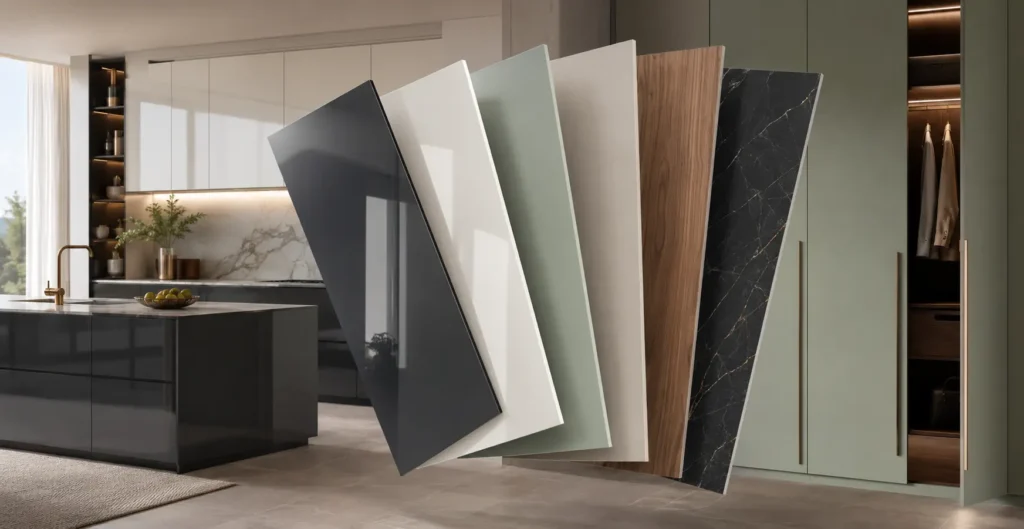
Acrylic laminates have become a popular surface-finishing choice for modern kitchens, wardrobes, TV units, offices and retail interiors. Their smooth appearance, rich colours and reflective finish can give ordinary furniture a clean and premium character.
Nexus 6H Acrylic Laminates are decorative acrylic sheets designed for vertical interior applications. The collection combines high-gloss, silky-matt, solid-colour, wood-inspired and stone-inspired designs. Each sheet is manufactured in a standard size of 2440 × 1220 mm with a nominal thickness of 1.5 mm.
The Nexus catalogue includes 32 shades and designs, allowing designers, homeowners, architects and furniture manufacturers to create coordinated interiors for residential and commercial spaces.
This guide explains the specifications, finish options, design collection, applications, installation process, maintenance requirements and important precautions for Nexus Acrylic Laminates.
What Are Nexus 6H Acrylic Laminates?
Nexus 6H Acrylic Laminates are decorative surface sheets intended to be bonded to suitable substrates such as MDF, plywood or particle board. They are used to finish furniture panels, shutters and selected interior wall elements.
The acrylic surface provides a smooth, uniform and visually refined appearance. Depending on the selected design, the final surface can have a highly reflective gloss, a soft silky-matt character, a solid colour, a natural wood appearance or a stone-inspired pattern.
The catalogue describes the sheets as lightweight, water resistant, stain resistant, anti-yellowing and resistant to surface scratches. It also identifies the product as suitable primarily for vertical indoor applications.
The term “6H” refers to the stated surface-hardness category. It indicates improved resistance to ordinary surface marks, but it does not mean that the laminate is completely impossible to scratch. Sharp objects, abrasive cleaners and improper handling can still damage the surface.
Nexus Acrylic Laminates: Quick Specifications
| Specification | Details |
|---|---|
| Product name | Nexus 6H Acrylic Laminates |
| Product category | Decorative acrylic laminate |
| Sheet size | 2440 × 1220 mm |
| Nominal thickness | 1.5 mm |
| Thickness tolerance | May vary by approximately ±5% between lots |
| Surface options | High gloss, silky matt, solid, wood-inspired and stone-inspired |
| Surface-hardness claim | 6H |
| Recommended use | Indoor vertical applications |
| Common substrates | MDF, plywood and particle board |
| Edge-band size shown | 1 mm × 22 mm |
| Edge-band availability | Available in coordinating shades |
| Installation adhesive | Compatible water-based PVAcP adhesive recommended |
| Protective film | Remove within the period specified in the installation instructions |
| Outdoor use | Not recommended |
| Direct sunlight | Avoid prolonged exposure |
| Cleaning | Water, suitable glass cleaner and soft microfibre cloth |
The sheet size and colour should be verified physically before cutting or installation.
Why Choose Nexus 6H Acrylic Laminates?
Premium Surface Appearance
Acrylic laminates are known for creating a smooth and sophisticated furniture surface. High-gloss designs reflect surrounding light and can make compact spaces feel brighter.
The silky-matt collection offers a softer alternative. It provides a more restrained appearance for interiors where strong reflections are not preferred.
Wide Selection of Designs
The Nexus collection contains 32 designs across several visual categories. It includes neutral colours, darker shades, brighter accent colours, wood-inspired patterns, stone-style designs and matt finishes.
This range makes it possible to use acrylic laminates in different interior styles without limiting every project to plain white or black surfaces.
6H Surface Hardness
The catalogue identifies the surface as 6H scratch resistant. This makes it suitable for furniture surfaces that receive regular contact during normal indoor use.
However, the rating should not be interpreted as a guarantee against every type of damage. Knives, metal tools, rough scrubbers, dragging objects and abrasive particles can still leave marks.
Water and Stain Resistance
Nexus states that its acrylic sheets are manufactured to repel water and stains for an extended period. This can make them useful for kitchen shutters, bathroom furniture and other indoor areas where surfaces may require frequent cleaning.
Water resistance applies to the decorative surface and should not be confused with waterproof furniture construction. Unsealed edges, joints and substrate material can still absorb moisture.
Lightweight Construction
The sheets are described as lightweight and easy to apply. Because the laminate is bonded over a supporting board, it can provide a premium decorative surface without requiring a heavy solid-acrylic furniture component.
Anti-Yellowing Properties
The collection is presented as anti-yellowing. This is especially relevant for light shades such as white, ash and pearl.
Even with an anti-yellowing surface, direct sunlight, excessive heat, unsuitable adhesives and chemicals can contribute to colour changes. The installation and maintenance instructions must therefore be followed.
Coordinating Edge Banding
The catalogue shows 1 × 22 mm edge-band tape available in matching shades. A coordinated edge band helps conceal the exposed edge of the substrate and gives shutters or furniture panels a more complete appearance.
Shade and batch compatibility should be checked before edge banding is applied.
Suitable for Multiple Interior Environments
Nexus positions the collection for living rooms, dining spaces, kitchens, bedrooms, offices and showrooms. The available colours make it possible to use the same material category across different furniture elements.
Complete Nexus 6H Acrylic Laminate Design Collection
The catalogue presents 32 shades and patterns. Actual colours may look different in print, on a phone or on a computer screen. A physical sample should always be checked before ordering.
| No. | Design name | General design character |
|---|---|---|
| 1 | Oscuro | Dark, bold decorative finish |
| 2 | Blanco | Clean and light neutral finish |
| 3 | Congo | Rich, warm interior shade |
| 4 | Antheracite | Deep anthracite-inspired tone |
| 5 | Formic | Refined neutral surface |
| 6 | Ash | Soft ash-toned finish |
| 7 | Claro | Light and contemporary shade |
| 8 | Piano | Deep, dramatic premium finish |
| 9 | Chino | Warm designer colour |
| 10 | Irish | Distinctive decorative shade |
| 11 | Arizona | Warm nature-inspired finish |
| 12 | Pearl | Light, elegant pearl-like surface |
| 13 | Marbo | Marble-inspired decorative design |
| 14 | Giallo | Bright, expressive accent colour |
| 15 | Menta | Fresh mint-inspired shade |
| 16 | Jade | Rich green-inspired finish |
| 17 | Harly | Contemporary statement shade |
| 18 | Azzurro | Cool blue-inspired finish |
| 19 | Tussock | Natural wood-style design |
| 20 | Wickham | Wood-inspired decorative pattern |
| 21 | Tico | Warm wooden character |
| 22 | Arizona Matt | Matt version of Arizona |
| 23 | Formic Matt | Soft-matt Formic surface |
| 24 | Piano Matt | Dark silky-matt finish |
| 25 | Menta Matt | Fresh matt accent shade |
| 26 | Ash Matt | Neutral silky-matt surface |
| 27 | Rubia Matt | Warm matt designer finish |
| 28 | Onyx | Dark stone-inspired pattern |
| 29 | Sagy Wood | Natural wood-inspired surface |
| 30 | Charcoal Marbo | Dark marble-inspired design |
| 31 | Grape Wine | Rich wine-inspired accent colour |
| 32 | Peanut | Warm earthy neutral shade |
Design descriptions are intended as general guidance. The final colour, grain and reflectivity should be evaluated using an original Nexus sample.
Nexus High-Gloss Acrylic Laminates
High-gloss acrylic laminates provide a reflective, glass-like visual effect. They are suitable for furniture where a bright, polished and contemporary appearance is required.
Gloss surfaces can reflect windows, ceiling lights and surrounding colours. This can make a kitchen or wardrobe feel more spacious, but it also means that lighting placement should be planned carefully.
High-gloss designs can be considered for:
- Modular kitchen shutters
- Wardrobe doors
- TV-unit cabinets
- Vanity-unit shutters
- Office storage
- Reception furniture
- Retail counters
- Display cabinets
The brochure recommends glossy surfaces for vertical applications. They should not be treated as direct replacements for heat-resistant kitchen worktops.
Nexus Silky-Matt Acrylic Laminates
The Silky Matt range provides a softer and less reflective appearance. Matt surfaces can make an interior feel calm, balanced and modern.
The collection includes:
- Arizona Matt
- Formic Matt
- Piano Matt
- Menta Matt
- Ash Matt
- Rubia Matt
Matt shades are particularly suitable for large wardrobe shutters, bedroom furniture, office cabins and interiors where strong reflections may be distracting.
Although matt finishes generally show fewer reflections, they still require proper cleaning. Oil, adhesive residue and harsh chemicals should not be used on the surface.
Wood-Inspired Acrylic Designs
Nexus includes designs that reproduce the warmth and visual character of wood. These options are useful when a natural look is preferred but a smoother acrylic surface is required.
Wood-inspired options include Tussock, Wickham, Tico and Sagy Wood. Other warm designs may also coordinate well with wooden flooring and furniture.
These patterns can be combined with plain colours. For example:
- Wood design with Blanco for a light modern kitchen
- Wickham with Piano for a dramatic TV unit
- Sagy Wood with Ash Matt for bedroom furniture
- Tico with Pearl for a warm commercial interior
A physical combination sample should be checked under the room’s actual lighting.
Stone-Inspired Acrylic Designs
Stone-inspired designs provide a decorative alternative to plain solid colours. Marbo, Onyx and Charcoal Marbo can be used to introduce marble- or stone-like visual movement into furniture.
These designs work well as selected highlights rather than covering every surface. They can be used on:
- TV-unit shutters
- Display cabinets
- Reception desks
- Bar-unit furniture
- Vanity cabinets
- Commercial counters
- Decorative vertical panels
Acrylic stone designs are decorative laminates. They should not be mistaken for natural stone or used where the structural and heat-resistant performance of stone is required.
Solid and Accent Colours
The range includes light neutrals, dark shades and more expressive colours. Blanco, Ash, Pearl and Claro can create bright and understated interiors. Piano, Antheracite and Oscuro offer a stronger and more dramatic look.
Menta, Jade, Azzurro, Giallo and Grape Wine can be used as accent colours. Instead of applying a bold shade across every cabinet, it may be more effective to use it on a central unit, overhead cabinet, display section or contrasting shutter group.
Applications of Nexus Acrylic Laminates
Modular Kitchen Shutters
One of the most common applications is the front surface of modular kitchen shutters. High-gloss acrylic can produce a bright contemporary appearance, while silky-matt shades create a quieter design.
The sheet should be bonded to a calibrated substrate. All edges must be finished correctly to help protect the board underneath.
The laminate should not be used as a worktop surface or placed where hot cookware can touch it directly.
Wardrobes
The 2440 × 1220 mm sheet format is suitable for many full-height furniture components after professional cutting and planning. Acrylic laminates can be applied to hinged and sliding wardrobe shutter systems when the construction is suitable.
Large panels must remain flat and adequately supported. Correct adhesive distribution and pressing are essential.
TV Units
High-gloss, wood-inspired and stone-inspired designs can all be used in TV-unit compositions. Dark acrylic surfaces can help visually integrate the television screen, while light shades can make the unit appear less heavy.
Electrical access, ventilation and mounting points should be planned before lamination and assembly.
Bedroom Furniture
Acrylic sheets can be used for bedside units, dressing tables, study units and selected headboard storage. Matt shades often work particularly well in bedrooms because they produce fewer reflections.
Bathroom Furniture
The brochure identifies bathroom furniture as one of the possible applications. The acrylic surface may resist ordinary water contact, but the substrate and edges must be protected from prolonged moisture.
The sheets should not be installed as a substitute for waterproof wall treatment inside a wet shower zone.
Living and Dining Areas
Acrylic laminates can finish crockery units, storage cabinets, bar furniture, sideboards and media consoles. Matching or contrasting designs can be used to connect furniture across living and dining areas.
Offices
The material can be used on office cabinets, workstations, reception counters, cabin storage and meeting-room furniture. Neutral shades provide a professional appearance, while accent colours can support brand identity.
Showrooms and Retail Spaces
Glossy acrylic surfaces can help display units look clean and polished. They are suitable for vertical counters, wall cabinets and product-display furniture where appearance is important.
Commercial applications should be planned according to the expected level of contact and cleaning.
Healthcare Furniture
Healthcare is listed among the potential applications in the catalogue. Any healthcare project should separately verify hygiene, chemical resistance, fire performance and regulatory requirements before specifying the material.
A general catalogue claim should not replace project-specific technical approval.
How to Select the Right Acrylic Laminate
Decide Between Gloss and Matt
Choose high gloss when a reflective, bright and luxurious appearance is required. Select silky matt when the design needs to feel softer and less reflective.
Room lighting is important. Gloss placed opposite a strong window may show intense reflections, while a matt finish may appear more balanced.
Check the Physical Colour
Screen settings, printing and photography can change the appearance of a shade. The catalogue itself warns that actual colours may vary from brochure images.
Check the original sample vertically inside the room where it will be installed.
Use Material from the Same Batch
The manufacturer advises using material from the same production batch to reduce visible colour variation.
Batch details should be checked before cutting. Mixing sheets from different batches on the same large furniture elevation may create a noticeable difference.
Coordinate the Edge Band
Confirm that the edge-band colour matches the selected laminate. Even a small difference can become visible on high-gloss white, dark and brightly coloured shutters.
Consider the Substrate
The final appearance depends heavily on the board beneath the acrylic sheet. An uneven or low-quality substrate may cause waves, weak bonding or air bubbles.
Use good-quality, flat and properly calibrated MDF, plywood or particle board according to the application.
Step-by-Step Installation Guide
Professional fabrication is strongly recommended for acrylic laminates. Incorrect adhesive selection, insufficient pressing or a poor substrate can cause bubbles, debonding and colour patches.
1. Verify the Original Product
Check the Nexus identification sticker and product details before installation. Confirm the shade, finish, sheet size, batch and physical condition.
2. Inspect for Transport Damage
Examine the laminate when it is delivered. Do not install a sheet that has been cracked, deeply scratched, stretched or damaged during transportation.
3. Store the Sheets Flat
Acrylic laminates should be stored straight and flat. The brochure advises against keeping them in roll form because rolling can create internal cracks or stretch lines.
If a sheet has been rolled, it should be kept flat for at least 48 hours before lamination.
4. Prepare the Substrate
Use a good-quality MDF, plywood or particle-board substrate with:
- An even surface
- Calibrated thickness
- Adequate strength
- Low and stable moisture
- No loose particles
- No oil or grease
- No deep dents or warping
The substrate should be cleaned with a cloth, sponge, soft brush or suitable sandpaper.
5. Choose a Compatible Adhesive
The catalogue recommends a compatible water-based PVAcP adhesive. It specifically references Durobond for the installation system.
The adhesive should be stirred gently before application. Water should not be mixed into it unless expressly permitted by its current technical instructions.
Synthetic rubber adhesives are not recommended in the brochure because they may contribute to brown or coloured patches.
6. Spread Adhesive Uniformly
Apply a consistent layer of adhesive to both the laminate and the substrate using a brush, roller or adhesive spreader.
Uneven application can leave dry areas where the laminate may later lift or develop bubbles.
7. Leave a Suitable Groove Between Pieces
The installation instructions recommend maintaining approximately a 2 mm groove between two laminate pieces. This helps provide working space and supports the removal of trapped air while pressing.
The final joint detail should be planned according to the furniture design and fabricator’s method.
8. Press from the Centre Outward
Use a soft pinch roller or an appropriate pressing system. Begin at the centre of the panel and work towards the sides and corners.
This method helps push trapped air away from the middle instead of sealing it beneath the surface.
9. Apply Sufficient Pressing Time
The brochure recommends maintaining sufficient pressure for approximately 12–15 hours to develop full bonding strength.
Actual curing requirements should also be checked on the adhesive packaging because temperature, humidity, substrate and adhesive quantity can affect bonding.
10. Remove the Protective Film
The protective film should not remain on the finished laminate indefinitely. The catalogue contains slightly different removal periods in different sections, including 6–7 days and 7–15 days after installation.
The safest approach is to follow the instruction printed on the supplied sheet and current product packaging. Confirm the permitted removal period with the supplier and remove the film promptly after fabrication and site work are complete.
Preventing Air Bubbles
Air bubbles are usually related to installation conditions rather than the decorative appearance of the sheet.
Possible causes identified in the brochure include:
- Incorrect or incompatible adhesive
- Uneven adhesive distribution
- High humidity during bonding
- Moisture in the substrate
- Uneven plywood, MDF or particle board
- Insufficient pressing
- Pressing for too little time
- Trapped air beneath the sheet
- Using oversized unsupported panel sections
- Installing a laminate that was stored in rolled form
- Loss of moisture from the substrate after installation
To reduce the risk, use a calibrated board, maintain stable workshop conditions, spread adhesive uniformly and press the laminate correctly.
Preventing Yellow Patches and Colour Fading
Yellow or brown patches can develop because of installation materials, heat or environmental exposure.
The brochure identifies the following risks:
- Inferior-quality dipped plywood
- Reactive lipping material
- Incompatible synthetic rubber adhesive
- Direct sunlight
- Prolonged heat exposure
- Hot cookware placed against the surface
- Solvent-based cleaning products
Use compatible boards, edge materials and adhesive. Install the laminate indoors and protect it from direct sunlight and excessive heat.
Cleaning and Maintenance
Acrylic laminates should be cleaned gently to preserve their gloss or matt finish.
Recommended cleaning method:
- Remove loose dust with a clean microfibre cloth.
- Dampen the cloth with clean water.
- Wipe the surface without applying excessive pressure.
- Use a suitable ordinary glass cleaner only when necessary.
- Dry the surface with another soft microfibre cloth.
Avoid:
- Abrasive cleaning pads
- Rough cotton waste
- Hard brushes
- Thinner
- Petrol
- Alcohol-based cleaners
- Solvent-based chemicals
- Pine-oil products
- Oil-based cleaners
- Metal scrapers
- Strong polishing compounds
Any cleaner should first be tested on an offcut or hidden section.
Important Dos and Don’ts
| Do | Don’t |
|---|---|
| Store sheets flat and straight | Do not store acrylic laminates in rolled form |
| Keep material below the recommended storage temperature | Do not expose it to prolonged heat |
| Use the same production batch on one elevation | Do not mix batches without comparing colours |
| Check sheets before cutting | Do not install damaged material |
| Use a smooth, calibrated substrate | Do not bond over an uneven or damp board |
| Use a compatible water-based PVAcP adhesive | Do not use an unapproved synthetic rubber adhesive |
| Spread adhesive evenly | Do not leave dry or overloaded sections |
| Press from the centre towards the edges | Do not trap air under the sheet |
| Use a soft microfibre cloth | Do not use abrasive scrubbers |
| Use laminates primarily on vertical surfaces | Do not treat them as kitchen worktops |
| Keep the surface away from direct sunlight | Do not use it outdoors |
| Remove the protective film on time | Do not leave the film attached indefinitely |
Are Nexus Acrylic Laminates Waterproof?
The catalogue describes the sheets as water resistant and stain resistant. This means the decorative acrylic surface can tolerate ordinary contact and cleaning better than many untreated surfaces.
However, the complete furniture panel is not automatically waterproof. Water may enter through:
- Exposed board edges
- Unsealed joints
- Handle cut-outs
- Sink-area openings
- Poor edge banding
- Screw holes
- Damaged corners
- The back of the substrate
All edges and joints must be properly finished, especially in kitchens, bathrooms and utility areas.
Are 6H Acrylic Laminates Completely Scratch-Proof?
No decorative furniture surface should be considered impossible to scratch. The 6H description indicates a stated level of surface hardness and resistance to normal contact.
The surface may still be damaged by:
- Sharp metal objects
- Knives
- Rough scrubbing pads
- Sand or abrasive dust
- Dragging appliances
- Construction tools
- Incorrect cleaners
- Improper removal of protective film
Using the correct cleaning method and handling furniture carefully will help maintain the finish.
Acrylic Laminate vs Ordinary Decorative Laminate
| Feature | Nexus acrylic laminate | Ordinary decorative laminate |
|---|---|---|
| Appearance | Premium gloss or silky-matt character | Available in many textures and finishes |
| Surface depth | Smooth and visually rich | Depends on product type |
| Reflectivity | High in gloss designs | Usually moderate unless high-gloss grade |
| Thickness in this collection | Nominal 1.5 mm | Varies by product |
| Recommended application | Primarily vertical furniture surfaces | Vertical and, for suitable grades, horizontal applications |
| Care requirements | Soft microfibre cleaning recommended | Depends on surface texture |
| Heat exposure | Direct heat should be avoided | Performance varies by grade |
| Outdoor use | Not recommended | Generally not recommended unless specially certified |
Selection should be based on the application, expected wear, budget and desired appearance.
Frequently Asked Questions
What is the size of a Nexus 6H Acrylic Laminate sheet?
The standard catalogue size is 2440 × 1220 mm, with a nominal thickness of 1.5 mm.
How many Nexus acrylic designs are available?
The supplied catalogue presents 32 named designs, including gloss, matt, solid, wood-inspired and stone-inspired options.
Where can Nexus acrylic laminates be used?
They can be used on suitable indoor furniture in living rooms, kitchens, bedrooms, offices, bathrooms and showrooms. The catalogue recommends vertical applications.
Can the laminate be used outdoors?
No. Outdoor use and exposure to direct sunlight or weather conditions are not recommended.
Can it be used on a kitchen countertop?
The brochure recommends glossy acrylic surfaces for vertical applications. The laminate should not be used as a direct hot-cookware surface or assumed to provide countertop performance.
Which substrate can be used?
Suitable substrates may include good-quality, flat and calibrated MDF, plywood or particle board.
Which adhesive is recommended?
The brochure recommends a compatible water-based PVAcP adhesive and references Durobond. Current adhesive and laminate instructions should be followed.
Why do air bubbles appear after installation?
Possible causes include an uneven substrate, moisture, high humidity, incompatible adhesive, poor adhesive coverage, trapped air or insufficient pressing.
How long should the laminate remain under pressure?
The brochure recommends adequate pressing for approximately 12–15 hours. The adhesive manufacturer’s curing instructions should also be checked.
When should the protective film be removed?
The catalogue gives different periods in different sections. Follow the instructions on the supplied sheet and current packaging, and confirm the correct period with the authorised supplier.
Can different batches be installed together?
The manufacturer advises using the same batch because colour variation may occur between production lots.
How should an acrylic laminate be cleaned?
Use clean water, a suitable mild glass cleaner and a soft microfibre cloth. Avoid solvents, alcohol, petrol, thinner, oils and abrasive materials.
Is matching edge banding available?
The catalogue shows 1 × 22 mm edge-band tape available in coordinating shades. Availability should be confirmed for the selected design.
Can a rolled acrylic sheet be installed immediately?
No. Sheets should be stored flat. If a laminate was rolled, the brochure recommends keeping it straight for at least 48 hours before pressing and installation.
Final Thoughts
Nexus 6H Acrylic Laminates provide a broad selection of premium decorative surfaces for modern interior furniture. Their standard 2440 × 1220 × 1.5 mm format, 6H surface-hardness claim, gloss and silky-matt options, water resistance and coordinating edge bands make them suitable for many residential and commercial projects.
The collection’s greatest strength is its design variety. It includes understated neutrals, dramatic dark shades, colourful accents, natural wooden patterns and stone-inspired surfaces. This allows the laminate to support both minimal interiors and statement furniture designs.
The final result, however, depends on more than the selected colour. A flat substrate, correct adhesive, uniform spreading, centre-to-edge pressing, adequate curing and timely removal of the protective film are essential. Direct sunlight, excessive heat, incompatible chemicals and abrasive cleaning should be avoided.
When the correct shade is selected from a physical sample and installed by an experienced fabricator, Nexus Acrylic Laminates can create clean, coordinated and visually impressive furniture for kitchens, wardrobes, living rooms, offices, showrooms and other indoor environments.